
Advanced Microscopy
and Histology

Advanced Microscopy
and Histology
Technical
Expert
The Advanced Microscopy and Histology Core Facility brings together six Infrastructure Units, offering a comprehensive suite of imaging technologies for high-resolution visualization of biological samples at both cellular and subcellular levels.
The facility supports a wide range of applications including live-cell imaging, 3D reconstruction, deep tissue imaging, and ultrastructural analysis.
In addition to advanced imaging approaches, the histology unit provides advanced histological and cytological processing of normal and pathological tissues for research purposes.
Activities include tissue fixation, dehydration, clearing, paraffin or cryo-embedding, microtome or cryostat sectioning, routine histochemical staining and whole-slide digitization service using semi-automated workflows.
Each Unit is equipped with advanced instruments designed to address the diverse needs of innovative biomedical research. In addition to advanced instrumentation, the facility provides expert user training, assisted imaging sessions, and comprehensive support for image acquisition, analysis, and interpretation.

Dr. Sara Centonze
INSTRUMENTS
The facility is equipped with:
Advanced Microscopy
- Leica TCS SP8 LIGHTNING Confocal Microscope
- Leica THUNDER 3D Imager System
- Leica STELLARIS 8 DIVE WLL-LSCM and 2P microscope
- JEOL JSM-IT500 InTouchScope Scanning Electron Microscope (SEM) equipped with Energy Dispersive X-ray Spectrometer (EDS)
- Nanolive CX-A
Histology
- Leica HistoCore Pearl Tissue Processor
- Leica HistoCore Arcadia C&H Tissue Embedding system
- Leica BioSystems CM1950 Cryostat
- Leica BioSystems HistoCore Biocut Microtome
Reserve instruments
To reserve instruments, use the “Agendo” management system: https://upo.agendoscience.com/.
Infrastucture units
The Advanced Microscopy Core Facility is composed of six Infrastructure Units:
1. Confocal microscopy unit
The confocal microscopy unit is equipped with a state-of-the-art Leica SP8 confocal microscope, offering high-resolution imaging for a wide range of biological samples.
The Leica SP8 confocal microscope features high-speed, high-sensitivity imaging with tunable excitation and spectral detection, making it ideal for multi-channel fluorescence imaging. It supports advanced techniques such as live-cell imaging, 3D reconstruction, and time-lapse studies. The system is widely used in cell biology, neuroscience, and developmental biology for detailed visualization of subcellular structures and dynamic processes.
The unit supports both fixed and live sample studies, providing flexible and advanced imaging solutions for research needs.
SCIENTIFIC SUPERVISOR
Prof. Marco Corazzari
Available services include:
-
Assisted imaging sessions.
-
User training.
-
3D image acquisition.
-
Live-cell imaging.
-
Image analysis support.
2. THUNDER Imaging System
The Leica THUNDER Imaging System combines widefield fluorescence microscopy with advanced computational clearing to deliver high-contrast, high-resolution images, even from thick or scattering specimens. It enables fast and gentle imaging of live or fixed samples, making it ideal for applications such as 3D cell culture, tissue sections, and organoids. The system is particularly suited for researchers seeking rapid, high-quality imaging without the complexity of confocal techniques.
SCIENTIFIC SUPERVISOR
Prof. Marco Corazzari
Available services include:
-
High-speed, high-contrast widefield fluorescence imaging of thick or complex samples.
-
3D imaging of organoids, tissue sections, and 3D cell cultures with computational clearing.
-
Live-cell imaging with minimal phototoxicity and photobleaching.
-
Multi-channel fluorescence imaging with fast acquisition times.
-
User training and support for image acquisition and basic image processing.
3. Two-photon excitation + white laser scanning microscopy
The Leica STELLARIS DIVE setup supports both confocal laser scanning microscopy and two-photon excitation imaging. It combines the White Light Laser confocal laser scanning microscope (WLL-STELLARIS) and two-photon excitation DIVE (Deep In Vivo Explorer) laser scanning device (2P-DIVE). WLL-STELLARIS allows flexible choice of fluorophores as well as determination of both excitation and emission spectra in situ. 2P-DIVE allows high resolution imaging deep in fixed and in vivo tissues.
Setup is equipped with an upright DM6 microscope, water and oil immersion objectives and is suitable for the acquisition of both thick fixed/live tissue/cell preparations and mounted culture cells or tissue slices. The setup also includes the FLIM-FALCON module, enabling fluorescence life-time imaging.
SCIENTIFIC SUPERVISOR
Prof. Dmitry Lim
The Unit offers:
-
Assisted imaging sessions.
-
User training.
-
3D image acquisition.
-
Live-cell imaging.
-
Image analysis support.
4. Scanning Electron Microscopy
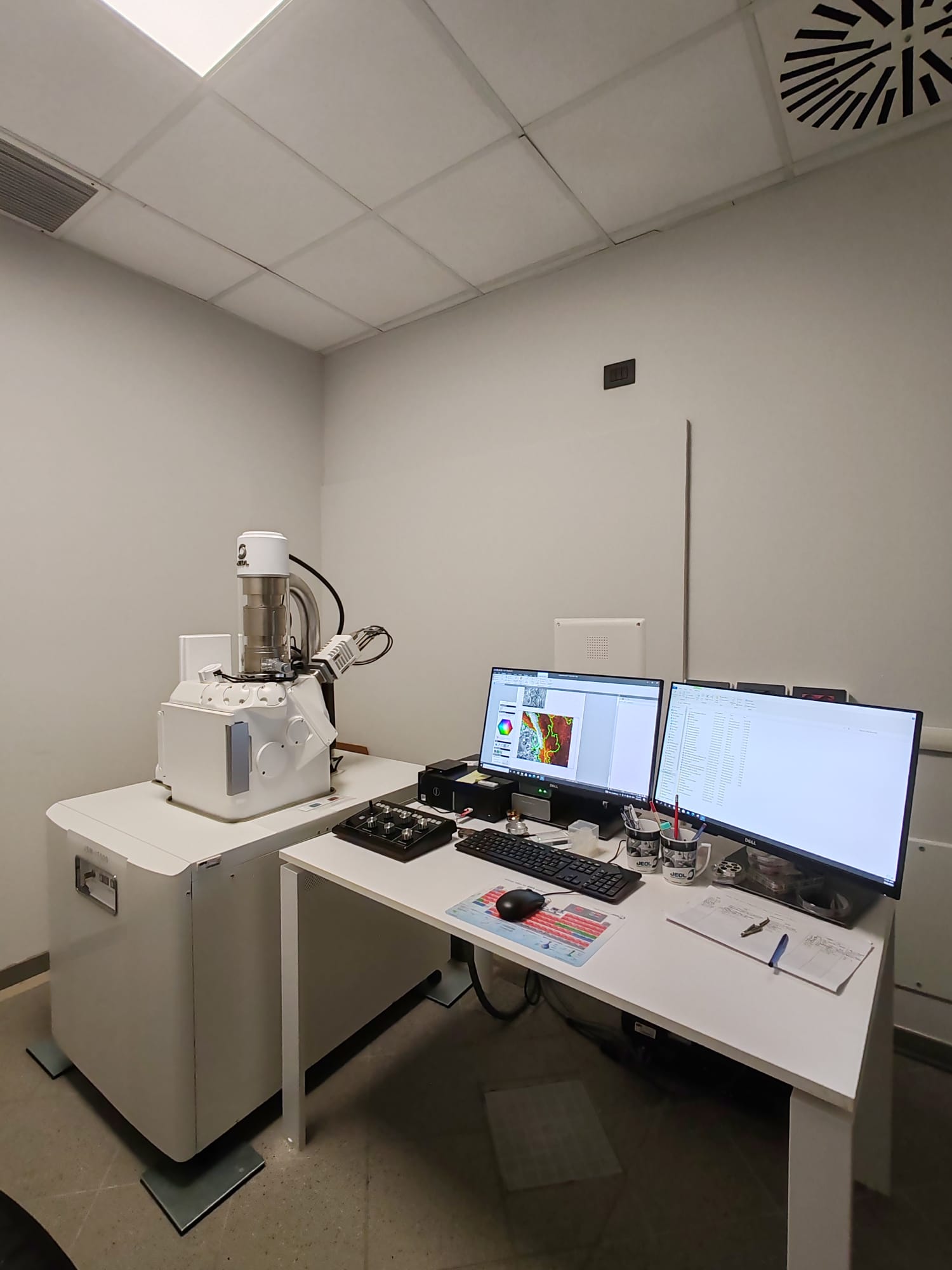
The scanning electron microscope (SEM) uses a focused beam of high-energy electrons to generate a variety of signals at the surface of solid specimens. The signals that derive from electron-sample interactions reveal information about the sample including external morphology (texture), chemical composition, and crystalline structure as well as orientation. The SEM is routinely used to generate high-resolution images of biological specimens to reveal morphology and interactions with substrates and it is equipped with an Energy Dispersive X-ray spectroscopy plug-in (EDS) allowing for the chemical characterization of the substrate/test element.
By SEM, allowed performances are: Direct magnification: x5 to x300000, Display magnification: x14 to x839724, Image mode: secondary electron, REF, composition, topographic, stereo-microscopic, Resolution (pixels): 640 x 480; 1280 x 960; 2560 x 1920; 5120 x 3840.
The EDS spectrometer allows for the following analysis: Spectral analysis, Qualitative & Quantitative analysis, Line analysis (horizontal line, specific direction line), Elemental mapping, Probe tracking.
SCIENTIFIC SUPERVISORS
Prof. Andrea Cochis, Prof. Lia Rimondini
The Unit offers:
-
Samples’ metallization (required to acquire conductivity).
-
Assisted imaging sessions.
-
User training.
-
Image acquisition.
-
Image analysis support.
5. Nanolive-Holotomographic Live Cell Imaging
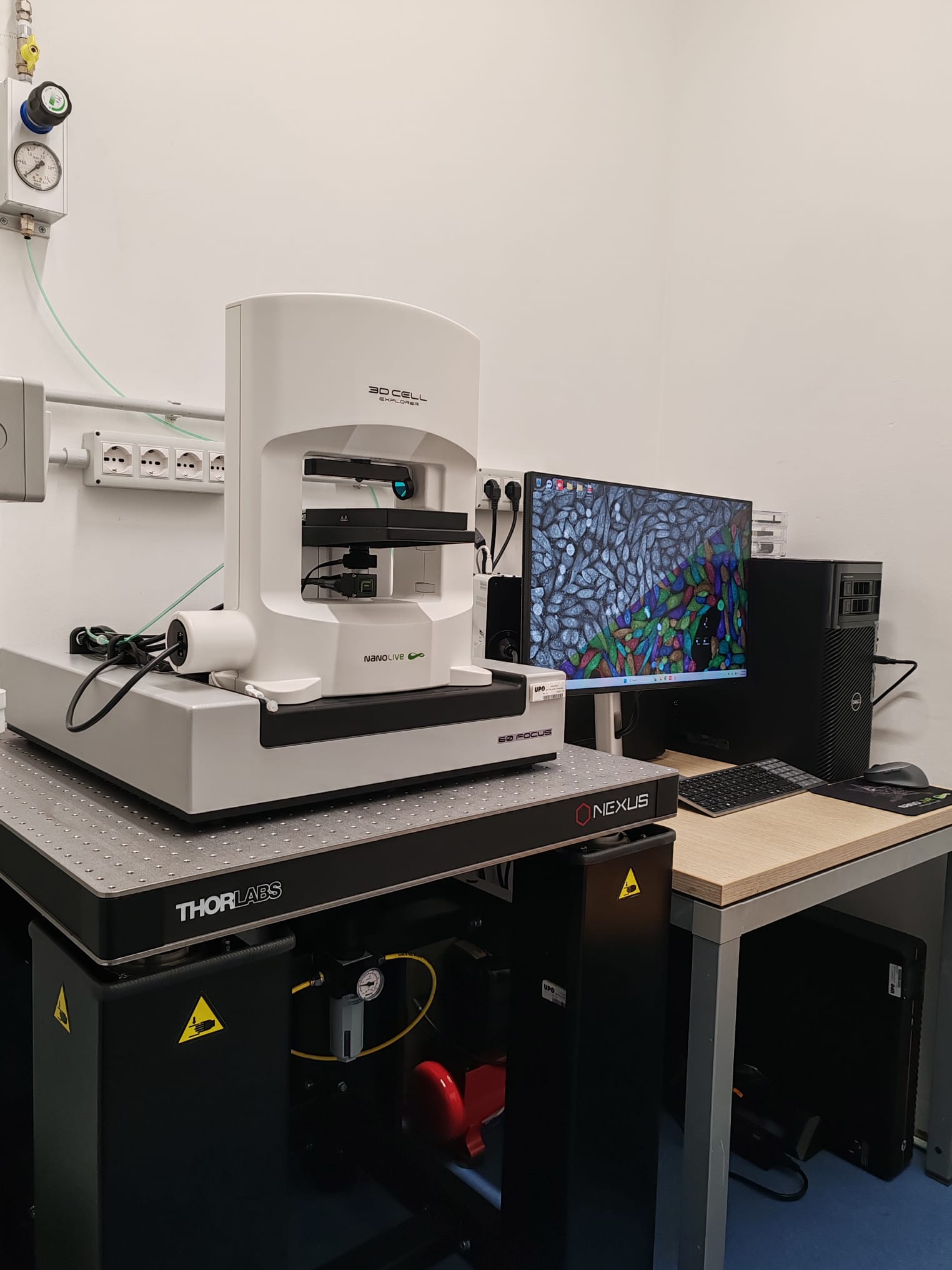
The Nanolive holotomographic microscope represents a significant innovation in high-resolution live-cell imaging. The synergy between holotomography and refractive index analysis allows for the observation of living cells in 3D and in real-time, completely eliminating the need for traditional fluorescent dyes or chemical labels. This approach mitigates the risks of phototoxicity, photobleaching, and the introduction of artifacts, enabling the study of cells in their most physiological state.
The presence of a stage incubator, compatible with both the 96-well plate and the 35 mm dish, ensures non-invasive, continuous live-cell acquisition over extended periods (days). The Nanolive system also includes three fluorescence channels, which can be utilized for advanced correlative imaging studies.
The Nanolive platform is supported by the EVE Analytics software, a user-friendly interface that enables quantitative cell segmentation and analysis. This tool provides a wide range of biologically relevant metrics (dry mass, cell count and confluency, cell area, circularity, perimeter, etc.).
In addition to these standard parameters, the Nanolive unit offers two specialized analysis software packages:
-
LIVE Cell Death Assay (LCDA): developed using state-of-the-art machine learning, the LCDA has been trained to distinguish not only between live and dead cells but also between different mechanisms of cell death, namely apoptosis and necrosis. This functionality is highly valuable for toxicology and pharmacological studies.
-
Smart Lipid Droplets Assay (SLDA): based on the high refractive index of lipids, the SLDA performs high-precision segmentation of lipid droplets within cells in a completely label-free manner. This tool is fundamental for research on lipid metabolism, obesity, and related pathologies.
SCIENTIFIC SUPERVISOR
Prof. Mariagrazia Grilli
The Unit offers:
-
Assisted imaging sessions.
-
User training.
-
3D image acquisition.
-
Live-cell imaging.
-
Image analysis support.
6. Fully Automated Organ-to-Section Tissue Processing Platform
Publications
Yamaguchi, I.; Barazzuol, L.; Dematteis, G.; Zhu, W.; Wen, Y.; Drobizhev, M.; Lim, D.; Campbell, R. E.; Calì, T.; Nasu, Y. Bipartite Genetically Encoded Biosensors to Sense Calcium Ion Dynamics at Membrane–Membrane Contact Sites. Anal. Chem. 2025, 97 (36), 19848–19861. https://doi.org/10.1021/acs.analchem.5c03831.
Monzani, R.; Gagliardi, M.; Saverio, V.; Clemente, N.; Monzani, A.; Rabbone, I.; Nigrelli, F.; Pellizzaro, S.; Ferrario, E.; Saettone, S.; Pagano, N.; De Leo, L.; Lim, D.; Sblattero, D.; Corazzari, M. Gliadin-Dependent UPR Induction Directly Triggers the Expression of TG2 and pro-Inflammatory Cytokines, Dysregulates Intestinal Permeability, and Reduces CFTR Expression in Intestinal Epithelial Cells of Celiac Disease Patients. Biol. Direct 2025, 20, 55. https://doi.org/10.1186/s13062-025-00644-9.
Tonelli, E.; Malecka, J.; Barberis, E.; Romano, C.; Pessolano, E.; Talmon, M.; Genazzani, A. A.; Casali, C.; Biggiogera, M.; Manfredi, M.; Tapella, L.; Lim, D.; Dematteis, G. Remodelling of Cellular Protein Homeostasis by Enhanced ER-Mitochondrial Tethering. Contact 2025, 8, 25152564251329704. https://doi.org/10.1177/25152564251329704.
Raiteri, T.; Reano, S.; Scircoli, A.; Zaggia, I.; Antonioli, A.; Faletti, S.; Favero, F.; Manfredi, M.; Pelicci, G.; Corà, D.; Scotti, L.; Kew, R. R.; Prodam, F.; Porporato, P. E.; Filigheddu, N. Vitamin D Binding Protein Induces Skeletal Muscle Atrophy and Contributes to Cancer-Associated Muscle Wasting Independently of Vitamin D Status in Preclinical Models. Nat. Commun. 2026. https://doi.org/10.1038/s41467-026-71530-9.
CONTACTS
For any information, please contact
corefacilities.ipazia@uniupo.it

For any information, please contact
corefacilities.ipazia@uniupo.it
or segreteria.caad@uniupo.
CAAD
Center for Translational Research on
Autoimmune and Allergic Disease
Centro di Ricerca Traslazionale
sulle Malattie Autoimmuni e Allergiche
Corso Trieste 15/A
Novara – 28100 (ITALY)
Advanced Microscopy
and Histology
Advanced Microscopy
and Histology
The Advanced Microscopy and Histology Core Facility brings together six Infrastructure Units, offering a comprehensive suite of imaging technologies for high-resolution visualization of biological samples at both cellular and subcellular levels.
The facility supports a wide range of applications including live-cell imaging, 3D reconstruction, deep tissue imaging, and ultrastructural analysis.
In addition to advanced imaging approaches, the histology unit provides advanced histological and cytological processing of normal and pathological tissues for research purposes.
Activities include tissue fixation, dehydration, clearing, paraffin or cryo-embedding, microtome or cryostat sectioning, routine histochemical staining and whole-slide digitization service using semi-automated workflows.
Each Unit is equipped with advanced instruments designed to address the diverse needs of innovative biomedical research. In addition to advanced instrumentation, the facility provides expert user training, assisted imaging sessions, and comprehensive support for image acquisition, analysis, and interpretation.


INSTRUMENTS
The facility is equipped with:
Advanced Microscopy
- Leica TCS SP8 LIGHTNING Confocal Microscope
- Leica THUNDER 3D Imager System
- Leica STELLARIS 8 DIVE WLL-LSCM and 2P microscope
- JEOL JSM-IT500 InTouchScope Scanning Electron Microscope (SEM) equipped with Energy Dispersive X-ray Spectrometer (EDS)
- Nanolive CX-A
Histology
- Leica HistoCore Pearl Tissue Processor
- Leica HistoCore Arcadia C&H Tissue Embedding system
- Leica BioSystems CM1950 Cryostat
- Leica BioSystems HistoCore Biocut Microtome
Reserve instruments
To reserve instruments, use the “Agendo” management system: https://upo.agendoscience.com/.
Infrastucture units
The Advanced Microscopy Core Facility is composed of six Infrastructure Units:
1. Confocal microscopy unit
The confocal microscopy unit is equipped with a state-of-the-art Leica SP8 confocal microscope, offering high-resolution imaging for a wide range of biological samples.
The Leica SP8 confocal microscope features high-speed, high-sensitivity imaging with tunable excitation and spectral detection, making it ideal for multi-channel fluorescence imaging. It supports advanced techniques such as live-cell imaging, 3D reconstruction, and time-lapse studies. The system is widely used in cell biology, neuroscience, and developmental biology for detailed visualization of subcellular structures and dynamic processes.
The unit supports both fixed and live sample studies, providing flexible and advanced imaging solutions for research needs.
SCIENTIFIC SUPERVISOR
Prof. Marco Corazzari
Available services include:
-
Assisted imaging sessions.
-
User training.
-
3D image acquisition.
-
Live-cell imaging.
-
Image analysis support.
2. THUNDER Imaging System
The Leica THUNDER Imaging System combines widefield fluorescence microscopy with advanced computational clearing to deliver high-contrast, high-resolution images, even from thick or scattering specimens. It enables fast and gentle imaging of live or fixed samples, making it ideal for applications such as 3D cell culture, tissue sections, and organoids. The system is particularly suited for researchers seeking rapid, high-quality imaging without the complexity of confocal techniques.
SCIENTIFIC SUPERVISOR
Prof. Marco Corazzari
Available services include:
-
High-speed, high-contrast widefield fluorescence imaging of thick or complex samples.
-
3D imaging of organoids, tissue sections, and 3D cell cultures with computational clearing.
-
Live-cell imaging with minimal phototoxicity and photobleaching.
-
Multi-channel fluorescence imaging with fast acquisition times.
-
User training and support for image acquisition and basic image processing.
3. Two-photon excitation + white laser scanning microscopy
The Leica STELLARIS DIVE setup supports both confocal laser scanning microscopy and two-photon excitation imaging. It combines the White Light Laser confocal laser scanning microscope (WLL-STELLARIS) and two-photon excitation DIVE (Deep In Vivo Explorer) laser scanning device (2P-DIVE). WLL-STELLARIS allows flexible choice of fluorophores as well as determination of both excitation and emission spectra in situ. 2P-DIVE allows high resolution imaging deep in fixed and in vivo tissues.
Setup is equipped with an upright DM6 microscope, water and oil immersion objectives and is suitable for the acquisition of both thick fixed/live tissue/cell preparations and mounted culture cells or tissue slices. The setup also includes the FLIM-FALCON module enabling fluorescence life-time imaging.
SCIENTIFIC SUPERVISOR
Prof. Dmitry Lim
The Unit offers:
-
Assisted imaging sessions.
-
User training.
-
3D image acquisition.
-
Live-cell imaging.
-
Image analysis support.
4. Scanning Electron Microscopy
The scanning electron microscope (SEM) uses a focused beam of high-energy electrons to generate a variety of signals at the surface of solid specimens. The signals that derive from electron-sample interactions reveal information about the sample including external morphology (texture), chemical composition, and crystalline structure as well as orientation. The SEM is routinely used to generate high-resolution images of biological specimens to reveal morphology and interactions with substrates and it is equipped with an Energy Dispersive X-ray spectroscopy plug-in (EDS) allowing for the chemical characterization of the substrate/test element.
By SEM, allowed performances are: Direct magnification: x5 to x300000, Display magnification: x14 to x839724, Image mode: secondary electron, REF, composition, topographic, stereo-microscopic, Resolution (pixels): 640 x 480; 1280 x 960; 2560 x 1920; 5120 x 3840.
The EDS spectrometer allows for the following analysis: Spectral analysis, Qualitative & Quantitative analysis, Line analysis (horizontal line, specific direction line), Elemental mapping, Probe tracking.
SCIENTIFIC SUPERVISORS
Prof. Andrea Cochis, Prof. Lia Rimondini
The Unit offers:
-
Samples’ metallization (required to acquire conductivity).
-
Assisted imaging sessions.
-
User training.
-
Image acquisition.
-
Image analysis support.
5. Nanolive-Holotomographic Live Cell Imaging
The Nanolive holotomographic microscope represents a significant innovation in high-resolution live-cell imaging. The synergy between holotomography and refractive index analysis allows for the observation of living cells in 3D and in real-time, completely eliminating the need for traditional fluorescent dyes or chemical labels. This approach mitigates the risks of phototoxicity, photobleaching, and the introduction of artifacts, enabling the study of cells in their most physiological state.
The presence of a stage incubator, compatible with both the 96-well plate and the 35 mm dish, ensures non-invasive, continuous live-cell acquisition over extended periods (days). The Nanolive system also includes three fluorescence channels, which can be utilized for advanced correlative imaging studies.
The Nanolive platform is supported by the EVE Analytics software, a user-friendly interface that enables quantitative cell segmentation and analysis. This tool provides a wide range of biologically relevant metrics (dry mass, cell count and confluency, cell area, circularity, perimeter, etc.).
In addition to these standard parameters, the Nanolive unit offers two specialized analysis software packages:
-
LIVE Cell Death Assay (LCDA): developed using state-of-the-art machine learning, the LCDA has been trained to distinguish not only between live and dead cells but also between different mechanisms of cell death, namely apoptosis and necrosis. This functionality is highly valuable for toxicology and pharmacological studies.
-
Smart Lipid Droplets Assay (SLDA): based on the high refractive index of lipids, the SLDA performs high-precision segmentation of lipid droplets within cells in a completely label-free manner. This tool is fundamental for research on lipid metabolism, obesity, and related pathologies.
SCIENTIFIC SUPERVISOR
Prof. Mariagrazia Grilli
The Unit offers:
-
Assisted imaging sessions.
-
User training.
-
3D image acquisition.
-
Live-cell imaging.
-
Image analysis support.
6. Fully Automated Organ-to-Section Tissue Processing Platform
Publications
Yamaguchi, I.; Barazzuol, L.; Dematteis, G.; Zhu, W.; Wen, Y.; Drobizhev, M.; Lim, D.; Campbell, R. E.; Calì, T.; Nasu, Y. Bipartite Genetically Encoded Biosensors to Sense Calcium Ion Dynamics at Membrane–Membrane Contact Sites. Anal. Chem. 2025, 97 (36), 19848–19861. https://doi.org/10.1021/acs.analchem.5c03831.
Monzani, R.; Gagliardi, M.; Saverio, V.; Clemente, N.; Monzani, A.; Rabbone, I.; Nigrelli, F.; Pellizzaro, S.; Ferrario, E.; Saettone, S.; Pagano, N.; De Leo, L.; Lim, D.; Sblattero, D.; Corazzari, M. Gliadin-Dependent UPR Induction Directly Triggers the Expression of TG2 and pro-Inflammatory Cytokines, Dysregulates Intestinal Permeability, and Reduces CFTR Expression in Intestinal Epithelial Cells of Celiac Disease Patients. Biol. Direct 2025, 20, 55. https://doi.org/10.1186/s13062-025-00644-9.
Tonelli, E.; Malecka, J.; Barberis, E.; Romano, C.; Pessolano, E.; Talmon, M.; Genazzani, A. A.; Casali, C.; Biggiogera, M.; Manfredi, M.; Tapella, L.; Lim, D.; Dematteis, G. Remodelling of Cellular Protein Homeostasis by Enhanced ER-Mitochondrial Tethering. Contact 2025, 8, 25152564251329704. https://doi.org/10.1177/25152564251329704.
Raiteri, T.; Reano, S.; Scircoli, A.; Zaggia, I.; Antonioli, A.; Faletti, S.; Favero, F.; Manfredi, M.; Pelicci, G.; Corà, D.; Scotti, L.; Kew, R. R.; Prodam, F.; Porporato, P. E.; Filigheddu, N. Vitamin D Binding Protein Induces Skeletal Muscle Atrophy and Contributes to Cancer-Associated Muscle Wasting Independently of Vitamin D Status in Preclinical Models. Nat. Commun. 2026. https://doi.org/10.1038/s41467-026-71530-9.
CONTACTS
For any information, please contact
corefacilities.ipazia@uniupo.it
For any information, please contact
corefacilities.ipazia@uniupo.it
or segreteria.caad@uniupo.
CAAD
Center for Translational Research on
Autoimmune and Allergic Disease
Centro di Ricerca Traslazionale
sulle Malattie Autoimmuni e Allergiche
Corso Trieste 15/A
Novara – 28100 (ITALY)